

THANK YOU FOR SUBSCRIBING


Logistics Tech Outlook Weekly Brief
Be first to read the latest tech news, Industry Leader's Insights, and CIO interviews of medium and large enterprises exclusively from Logistics Tech Outlook
A featured contribution from Leadership Perspectives: a curated forum reserved for leaders nominated by our subscribers and vetted by our Logistics Tech Outlook Advisory Board.


The U.S. economy-she’s a bit like that unpredictable uncle at Thanksgiving who one moment is charming everyone and the next is trying to explain the latest conspiracy theory. But what’s even more fascinating than the ups and downs of our economy is how the transportation industry and Wall Street are basically frenemies. They’re both in the same house (our economy), often working in tandem, but sometimes, they’re as opposite as a dry van and a flatbed.
I’ve spent years watching transportation rates bounce around like a pinball in an arcade and yet, somehow, the S&P 500—the beloved barometer of Wall Street—acts like it’s living in an entirely different universe. Let’s dig into some data from recent years to see just how these two unpredictable siblings, the transportation industry and the stock market, interact. Spoiler alert: it’s not always pretty, but it is interesting.
Remember 2020? Of course, you do. It was the year when everyone’s life flipped upside down and the economy was no exception. At first, the pandemic hit the transportation industry hard. Freight rates were coming out of deflation in early 2020, but as soon as people realized they needed to stock up on toilet paper (and everything else), the sector made a stunning pivot to rocketing inflation. By the end of the year, linehaul rates skyrocketed by a staggering 44.2% Y/Y change. Meanwhile, Wall Street, after a brief March panic, ended up having one of its best years ever. The S&P 500 rose by 63.8%—like it had just won the lottery.
“The only thing you can count on is that everything will change-probably tomorrow.”
Fast forward to 2021and the freight industry was booming. Linehaul rates soared by an eye-watering 57.6%, thanks in large part to the surge in e-commerce. People were buying everything under the sun from couches to home fitness equipmentand someone had to deliver all those packages. The stock market also rode the wave, with the S&P 500 posting an 85.4% Y/Y gain in Q3. It was one of those rare moments where both Wall Street and the transportation industry were winning big—maybe we were all in this together after all?
By the time 2022 rolled around, the party was over. Both the stock market and freight rates started to feel the effects of inflation and rising interest rates. Linehaul rates plummeted by 30.3% Y/Yand the S&P 500 wasn’t far behind, falling 15.4% Y/Y. You’d think we were back in 2015 again, with Wall Street and transportation giving each other the cold shoulder.
And the past 2 years? Well, it’s been rough, to say the least. Freight rates started the 2023 down by 32.7% Y/Y, while the stock market did its best to pretend everything’s fine with a modest 6.2% gain. But don’t let that fool you—both indices are still feeling the heatand Q4 2024 into 2025 promises to be a critical time for recovery.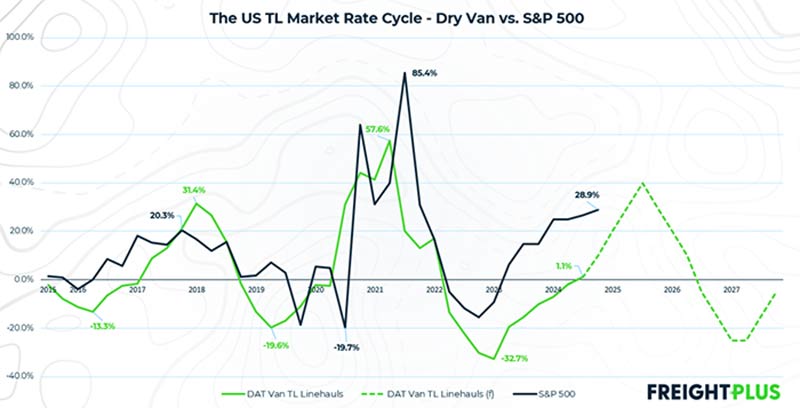
So, what have we learned from this wild ride? The transportation industry and Wall Street are deeply connected, but they don’t always move in sync. When Wall Street’s up, the freight industry lags mirroring similar inflationary trendsand yet when linehaul rates deflate, Wall Street is not far behind. But one thing’s for sure: both sectors are critical barometers of the health of the U.S. economy. The next time you see the S&P 500 soaring or freight rates tanking, just remember—they’re like those siblings who fight, but deep down, they need each other to keep the household running smoothly.
And as someone who's been in the trenches of freight brokerage for years, I can tell you: the only thing you can count on is that everything will change—probably tomorrow.
