THANK YOU FOR SUBSCRIBING


Logistics Tech Outlook Weekly Brief
Be first to read the latest tech news, Industry Leader's Insights, and CIO interviews of medium and large enterprises exclusively from Logistics Tech Outlook


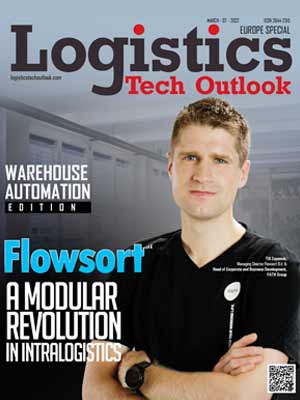
 Eric Willems, Founder of Flowsort, Till Zupancic, Managing Director
Such colossal transformation of businesses is also indicative of a huge influx in overall order placement, which is not only stressing the entire supply chain but also a company’s intralogistics.
Many consumers have now come to expect same- or next-day delivery not only from e-commerce and retail giants but from other small- and medium-sized sellers as well. This consumer expectation is pushing many e-commerce businesses to move their distribution centres closer to cities and create micro-fulfilment centres for delivering products to the consumer at a faster pace. While e-commerce businesses need to optimise their product delivery speed from fulfilment centres to consumers, they also need to optimise the product movement within the distribution centre itself. This is precisely where the challenge lies. Interestingly, solving this impediment and bringing a modular approach to intralogistics automation is where Flowsort—one of the top 10 warehouse-automation innovators—cements its cornerstone. Flowsort has developed a range of modular and automated sortation systems, which are an integral part of intralogistics automation. “With our 25 years of experience in the industry, we have developed a range of modular sortation systems that can be used even in a smaller facility,” underlines Eric Willems, the founder of Flowsort.

Willems explains that the common market-available intralogistics automation solutions are bulky and expensive, making them only ideal for large order fulfilment centres. “For example, many e-commerce businesses have been using an automated cross belt, tilt tray, and shoe sorters as part of their intralogistics systems. These automated solutions are capable of sorting more than 12,000-15,000 parcels per hour. But, since multiple micro-fulfilment centres share the parcel distribution load of a particular city, no distribution centre typically has to process more than 4,000- 5,000 products per hour,” elaborates Willems. Hence, the ROI of these costly automation solutions are seldom fully realised, thereby making the traditional intralogistics automation solutions a cost-ineffective investment for urban fulfilment centres. These businesses can instead use Flowsort’s modular and automated sortation systems as an alternative to costly and bulky sortation systems. Flowsort distributes these modular sortation solutions to the e-commerce and 3PL businesses through intralogistics system integrators and conveyor belt manufacturers. The modular design of the Flowsort sorting equipment lets system integrators and conveyor manufacturers purchase the sorting modules that fit their client’s unique requirements. From there, system integrators can add extra modules to their clients’ intralogistics systems to meet future needs, offering continuous scalability while keeping the initial investment much lower.
Flowsort offers its highly flexible sorting modules in three different categories, single-line diverters (SLD), double-line diverters (DLD), and zigzag diverters (ZZ). These diverters are available in 400-450mm/600- 650mm/800-850mm/1,000-1050mm widths. Besides, Flowsort has an “open interface” approach, meaning that both hardware and software connectivity is plug-and-play with all other surrounding technologies, regardless of which vendor those technologies are from. What more is that the principle to sort out products in a flow without mechanical forces, abrupt braking, or accelerating makes Flowsort’s sortation systems suitable to handle even sensitive parcels, whereas abrupt braking causes damage to the goods. “Thus, staying true to our name, Flowsort (flow + sorting), we aim to bring a very simple yet substantial solution for more effective sorting,” states Till Zupancic, managing director at Flowsort.

With our 25 years of experience in the industry, we have developed a range of modular sortation systems that can be used even in a smaller facility

Simplifying the Intralogistics Automation
Since Flowsort’s sorters come as baseline modules, system integrators can directly use those solutions in their new conveyor and sorting system designs or make adjustments within the system to adapt the sorting system for a variety of other use cases. They can combine multiple sortation modules and meet the process requirements of diverse sorting applications at the delivery and order fulfilment centres. “This flexibility is also one of the many reasons why intralogistics system integrators love Flowsort sortation systems, as these solutions are easy to install and integrate with other intralogistics technologies at their clients’ distribution or order fulfilment centres,” says Zupancic. For e-commerce and 3PL businesses, on the other hand, the benefits are around layout flexibility, scalability and universal applicability. The layout flexibility is given by the width variants and the possibility to realise any divert angle between -90 to +90 degrees.
Companies can easily increase the number of sorting points by adding more Flowsort sorting modules as their business grows.
Company
Flowsort
Management
Eric Willems, Founder of Flowsort, Till Zupancic, Managing Director
Description
With 25 years of experience in the intralogistics market, Flowsort has developed a range of modular sortation systems that can be used even within smaller distribution and order fulfilment centres. Flowsort offers its highly flexible sorting modules in three different categories, single-line diverters (SLD), double-line diverters (DLD), and zigzag diverters (ZZ). These diverters are available in 400-450mm / 600-650mm / 800-850mm / 1,000-1050mm widths. Flowsort has an "open interface" approach, meaning that both hardware and software connectivity is plug-and-play with all other surrounding technologies, regardless of which vendor those technologies are from.